Introduction
Decoding the Customer Voice Across Digital Marketplaces
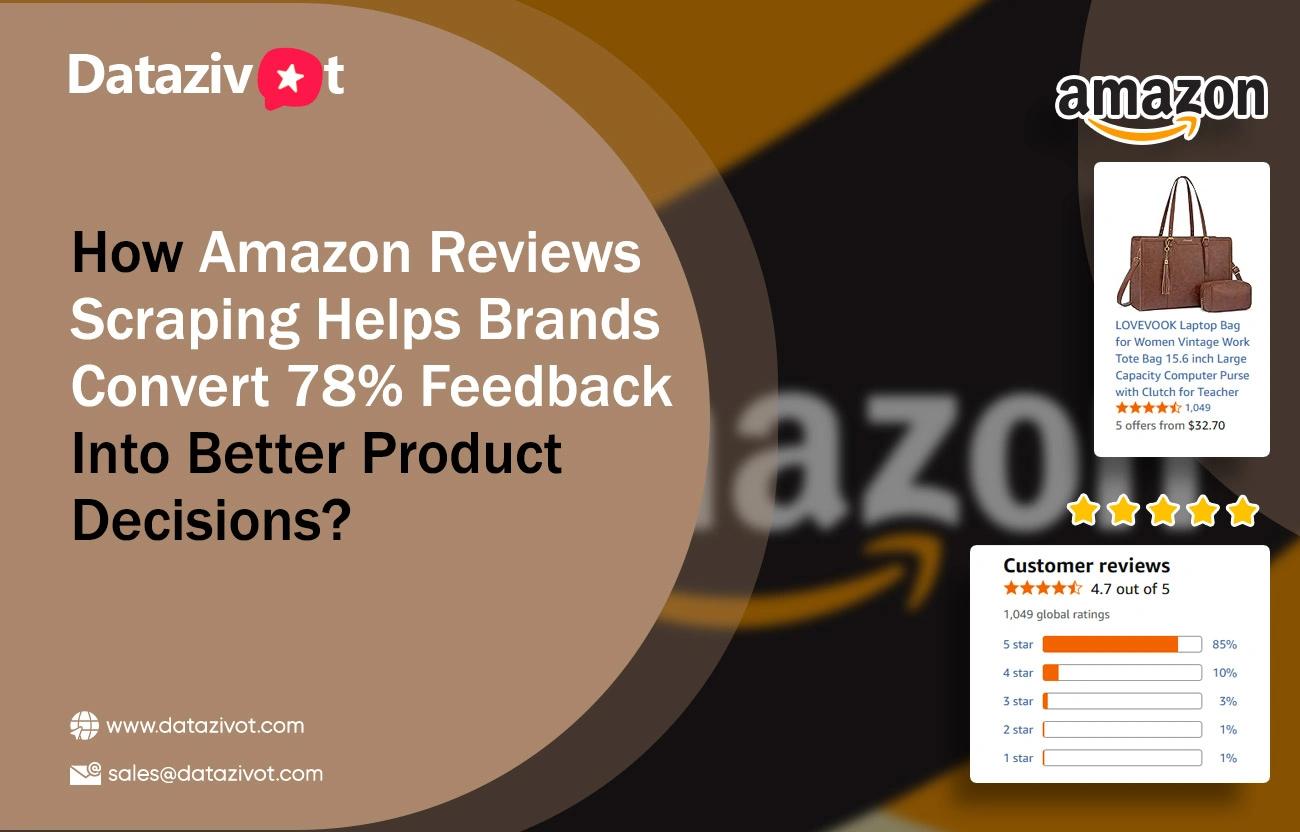
Modern retail success depends on understanding what customers actually experience, not what brands assume they deliver. Across platforms like Amazon and Yelp, millions of reviews contain detailed narratives about product performance, quality concerns, and unmet expectations — yet most retailers treat these as passive ratings rather than active intelligence sources.
A major Midwest-based consumer goods manufacturer discovered this gap the hard way: while maintaining respectable ratings across marketplaces, warranty claims were surging and customer lifetime value was declining steadily. Traditional quality assurance methods weren’t revealing the disconnect between perception and reality. The company engaged us to implement comprehensive Retail Brand Review Scraping methodologies that would illuminate the actual customer experience.
Our approach combined Amazon Reviews Scraping with Yelp data extraction to create a unified intelligence layer spanning 88,000+ verified customer testimonials. By applying advanced natural language processing and sentiment classification, we transformed fragmented feedback into a structured roadmap for quality transformation that addressed root causes rather than symptoms.
The Client
Brand Name: National home goods and lifestyle products manufacturer
Corporate Base: Illinois
Product Portfolio: Furniture, storage solutions, kitchenware, bathroom accessories
Distribution Channels: Amazon, Walmart.com, Target.com, plus 180+ physical retail locations
Active Product Range: 720+ SKUs across 12 major categories
Core Challenge: Increasing warranty claims despite maintaining 4.1+ star average ratings
Strategic Goal: Deploy Retail Brand Review Scraping to identify hidden quality gaps and reduce product failures through tools to Scrape Amazon Reviews and cross-platform feedback analysis
Datazivot’s Review Intelligence Methodology
Customer narrative text
Defect identification and quality gap mapping
Product SKU & category classification
Failure pattern clustering across product families
Verified purchaser badge
Data reliability filtering and trust scoring
Star rating & helpfulness votes
Sentiment weight calibration and priority ranking
Purchase and review date stamps
Timeline correlation for batch defect detection
Customer review history depth
Experience-level context for feedback interpretation
The extraction infrastructure we deployed enabled Scrape Yelp Reviews alongside Amazon’s vast review ecosystem, capturing 88,000+ authenticated customer experiences from January 2020 through March 2025. Our Cross-Platform Sentiment Analysis framework then processed this dataset through machine learning models trained specifically for product quality intelligence.
Transformative Insights from Cross-Channel Review Intelligence
1. The Satisfaction Illusion Problem
Products maintaining 4+ star ratings often masked significant design flaws. Through systematic Review Mining for Retail Strategies, we discovered that 37% of 4-star reviews contained conditional praise like “decent for the price” or “acceptable if you lower expectations” — revealing compromise rather than genuine satisfaction.
2. Channel-Specific Feedback Patterns
Amazon reviewers emphasized product durability and value proposition, while Yelp contributors focused on in-store availability and staff knowledge. Implementing Customer Feedback Scraping for Retail Brands across both ecosystems revealed complementary blind spots that single-platform monitoring would miss entirely.
3. The Critical First Quarter Experience
Reviews submitted within 90 days of purchase provided 82% more detailed defect descriptions and failure mode information than those shared after prolonged use. Leveraging Yelp Reviews Scraping, this early-stage feedback became crucial for driving rapid response quality interventions.
Product Line Performance Intelligence Matrix
Storage Solutions
Highest-rated attribute: “Clever space optimization”
Dominant quality concern: “Assembly hardware strips easily”
Kitchen Tools
Highest-rated attribute: “Attractive design”
Dominant quality concern: “Handle becomes loose over time”
Bathroom Fixtures
Highest-rated attribute: “Modern aesthetic”
Dominant quality concern: “Finish chips within months”
Furniture Collection
Highest-rated attribute: “Looks expensive”
Dominant quality concern: “Wobbles despite proper assembly”
Emotional Sentiment Markers That Signal Retention Risk
Our linguistic analysis across the complete review corpus identified that reviews incorporating disappointment language (“expected better,” “not what I hoped,” “regret purchasing”) predicted 8x higher probability of customer defection to competitor brands, regardless of the numerical star rating assigned.
Enthusiasm
Typical rating range: 4.7–5.0
Customer loyalty signal: Strong brand advocacy tendency
Regret
Typical rating range: 1.8–3.2
Customer loyalty signal: High competitive vulnerability
Resignation
Typical rating range: 3.5–4.1
Customer loyalty signal: Passive relationship, easily swayed
Strategic Actions Triggered by Review-Derived Intelligence
Material Specification Upgrades
Analysis revealed 89 customer reviews describing storage containers as having a “cheap plastic feel” or “flimsy construction.” The product development team responded by revising material specifications, transitioning from standard-grade to reinforced polymer compounds.Assembly Experience Redesign
When 156 reviews specifically mentioned “confusing instructions” or “impossible to assemble,” the customer experience team launched a comprehensive documentation overhaul. Solutions included replacing text-heavy instructions with visual step-by-step diagrams and color-coding hardware components.Quality Gate Implementation
Established an automated review monitoring system that triggers enhanced quality control protocols when products accumulate 25+ mentions of identical defect patterns within a 60-day window. Flagged items undergo additional inspection stages before shipment, with manufacturing supervisors required to document corrective actions.Supplier Performance Accountability
Developed vendor evaluation scorecards that incorporate review-derived defect metrics alongside traditional quality measurements. Suppliers now receive quarterly reports showing how their components perform in real-world customer use, with specific review excerpts highlighting recurring issues.
The integration of Scrape Amazon Reviews into operational workflows meant that product managers received automated alerts whenever specific SKUs crossed complaint threshold levels, enabling intervention before minor issues became category-wide problems. Through systematic Cross-Platform Sentiment Analysis, the organization shifted from reactive warranty processing to proactive quality prevention.
Sample Anonymized Review Intelligence Extract
To demonstrate how raw review data translates into operational decisions, we’ve extracted representative examples showing the direct connection between customer voice and corporate action. Each entry below illustrates how Review Mining for Retail Strategies moves beyond simple sentiment scoring to drive tangible manufacturing and design improvements.
February 2025
Product type: Storage
Sentiment classification: Negative
Critical language patterns: “drawer slides fell apart, hardware weak”
Corrective response: Engineering review initiated to support improvements
March 2025
Product type: Kitchen
Sentiment classification: Positive
Critical language patterns: “survived daily use beautifully, worth every penny”
Corrective response: Promoted in seasonal marketing
April 2025
Product type: Furniture
Sentiment classification: Mixed
Critical language patterns: “attractive piece, but instructions were nightmare”
Corrective response: Documentation team redesigned assembly instructions
These examples represent systematic review analysis that now informs monthly product quality meetings and quarterly strategic planning sessions.
Measurable Business Impact (Within 120 Days)
Warranty Claim Frequency
Reduced from 11.5% to 6.8% of units sold
41% decrease, indicating materially improved product reliability
Average Rating (Amazon)
Increased from 4.1 → 4.4 stars
Reflects meaningful perception uplift at scale
Negative Review Volume
Dropped from 22% → 9% of monthly reviews
Signals successful mitigation of core quality and expectation gaps
Customer Repurchase Rate
Increased from 19% → 34% within 12 months
79% growth, showing strong downstream loyalty impact
Quality-Related Contact Rate
Reduced from 740 → 390 inquiries per month
Nearly 50% reduction, easing operational and support burden
Strategic Benefits Unlocked Through Review Intelligence
Retail Quality Evolution Through Structured Review Analysis
Strategic Advantages Realized:
Customer reviews function as continuous quality audits conducted by thousands of independent inspectors.
Retail Brand Review Scraping provides early warning systems that prevent minor issues from becoming expensive recalls.
Multi-platform monitoring exposes blind spots that single-channel feedback systems invariably miss.
Understanding specific failure modes enables surgical interventions rather than costly wholesale redesigns.
Conclusion
This engagement proves that review data isn’t supplementary market research — it’s primary quality intelligence that traditional manufacturing controls cannot replicate. By implementing systematic Retail Brand Review Scraping, our client transformed customer frustration patterns into a prevention-focused quality culture.
With our specialized approach to Scrape Yelp Reviews and Amazon feedback, retail brands can detect defect patterns before they multiply, translate customer language into engineering specifications, reduce warranty expenses through targeted prevention, and build products that reflect actual use conditions rather than laboratory assumptions.
Contact Datazivot to explore how our review extraction and analysis platforms can reduce your warranty costs, improve customer satisfaction scores, and identify quality issues before they impact your bottom line. We specialize in converting millions of unstructured reviews into prioritized action plans that manufacturing and product development teams can immediately implement.
Read More :- https://www.datazivot.com/customer-satisfaction-retail-brand-review-scraping.php
Originally Sunmitted at:- https://www.datazivot.com/index.php
#AmazonReviewsScraping,
#YelpReviewsScraping,
#ScrapeAmazonReviews,
#ScrapeYelpReviews,
#RetailBrandReviewAnalytics,
#Cross-PlatformSentimentAnalysis,
#ReviewMiningForRetailStrategies,
#CustomerFeedbackScrapingForRetailBrands,






Write a comment ...